- Tickers
- NESTLE, HBL, FRSM, HABSM
One-sentence thesis
The same reporting end date can represent very different reporting periods, so the period label must be checked before revenue, profit, margins or EPS are compared.
- An ending date tells you where the reporting period stops, not how long it lasted.
- A quarter, half year and nine months can all end on 30 June.
- Comparison becomes unreliable when the time periods do not match.
Company financial calendar → reporting-period label → correct comparable period → cleaner earnings interpretation.
What happened
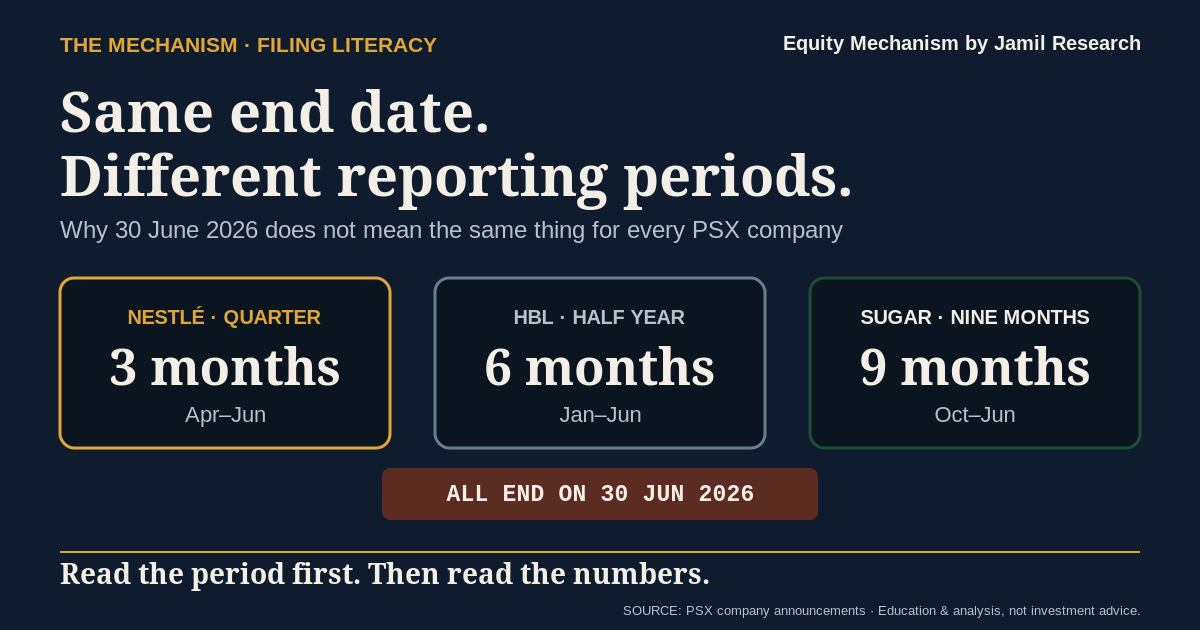
Several PSX disclosures used 30 June 2026 as the ending date, but they did not all cover the same number of months.
- Nestlé is used as a quarter example.
- HBL is used as a half-year example.
- Faran Sugar and Habib Sugar are used as nine-month examples.
The endpoint matches. The duration does not.
The mechanism
A company result gives two separate pieces of information:
- where the period ends
- how much time the result covers
The first item is a date. The second comes from the reporting label and the company’s financial calendar.
This distinction is important because a result covering three months should not be read as though it covers six or nine months.
Verified fact: The examples use the same 30 June 2026 ending date but different reporting-period labels.
Named inference: Readers should match the period before interpreting relative revenue, profit, margins or EPS. This is an analytical reading rule, not a judgement on the quality of any company.
What supports the view
The logic is built into the reporting structure itself. A quarter, half year, nine months and full year are different units of time. Direct comparison requires the same unit or a clearly adjusted basis.
What weakens the view
A reporting label alone does not explain business quality, seasonality, one-off items or consolidated differences. It is the first check, not the complete analysis.
The main risk is overextending a filing-literacy lesson into a company-performance conclusion. This article does not say whether any of the named companies delivered strong or weak results.
Check these before comparing results
Before comparing company results, check:
- quarter, half year, nine months or full year
- period ended
- financial year-end
- consolidated or unconsolidated basis
- same period from the previous year
Sources & notes
- Pakistan Stock Exchange company announcements and company pages